The Royal Festival Hall organ @ 70
Saturday 23 March 2024
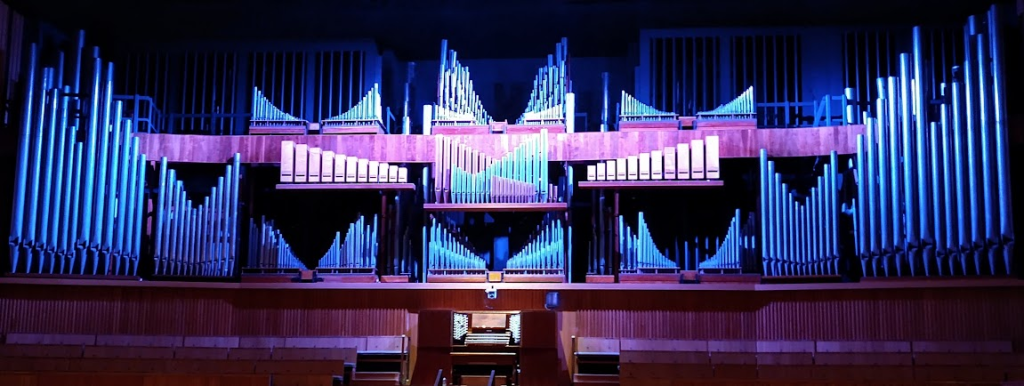
I have played organs dating back to the fifteenth and sixteenth centuries, so the 70th birthday of an organ might not appear to be that big a deal. But the organ in London’s Royal Festival Hall made an important, if controversial, contribution to the post-war British organ world. Designed by Ralph Downes, it was based on the Organ Reform Movement (Orgelbewegung) which started in Germany in the 1920s (with the enthusiastic support of Albert Schweitzer) and sought to reflect the style and construction techniques of pre-19th century organs, notably, in the early days, with a focus on the more historically informed performance of Bach. A detailed history of the RFH organ can be found here. Below is a photo of Ralph Downes inside the RFH organ with one of the tuners from the organ builders Harrison & Harrison of Durham, from his book Baroque Tricks.

A weekend of events in celebration of the birthday started at lunchtime on Saturday 23 March in the foyer of the Queen Elizabeth Hall with Let’s Build an Organ, a delightfully presented introduction to the organ aimed at younger enthusiasts, given by Duncan Chapman and the curator of the RFH organ, William McVicker, pictured with Andrew Scott, director of builders of the RFH organ, Harrison & Harrison of Durham.

Although they didn’t actually build an organ, they had one they prepared earlier and demonstrated aspects of organ technology using inventive processes, including a giant blow-up balloon which they encouraged children to sit on to demonstrate the working of organ bellows.

There was also a guide-to-the-organ handout, designed and drawn by pupils from two primary schools that have been following the recent restoration of the RFH organ. It included a snakes and ladders (or, in the case, a Pipes and Gluepots) game and opened up to a wide-spread explaining several of the more complex aspects of organ construction.


Let’s Build an Organ was followed (at 2pm) by the first of two organ recitals on the RFH organ, both given by James McVinnie, who has just started a year-long residency at the Southbank Centre. His first programme featured the type of music that might have influenced Ralph Downes when he conceived the RFH organ. Following an initial sequence of transcriptions of early Renaissance dances (which seemed to me to be performed in a style that might have reflected that of the date of the organ), McVinnie moved onto more traditional organ repertoire of the 17th to 18th century with pieces by Sweelinck, Pachelbel, Böhm, Buxtehude and Bach, culminating in Bach’s monumental Prelude and Fugue in E minor (BWV.548) with its famous ‘Wedge’ fugue. Exploring the vast array of individual colours available on the organ, James McVinnie, demonstrated the organ well and, although some aspects of his playing and registrations might not have met the approval of early music aficionados, he certainly impressed the large audience. I particularly liked his performance of the delightful Böhm Vater unser im Himmelreich and the powerful Praeludium in F sharp minor by Buxtehude.
The organ was restored and re-configured by Harrison & Harrison and was re-inaugurated on its 60th anniversary in March 2014. The difference in sound is particularly noticeable, particularly in the bass registers, and the improvement to the originally rather severe acoustics of the hall also adds to the overall sound.
The recital was followed by a discussion with James McVinnie and the RFH organ curator William McVicker and a between McVicker and Andrew Scott of Harrison & Harrison which focussed on the history of the organ and changes during the most recent restoration.
The evening concert was a very different affair from the earlier one. It was the UK premiere of Infinity Gradient for organ & 100 speakers by Tristan Perich. Commissioned by James McVinnie in 2021 it has already had several performances around the world, but the RFH is seen as its natural home. A recording will be made for future release. The photo shows the 100-speaker layout from an earlier performance, but the RFH layout was similar, although spread wider on the stage below the organ. A discussion between the composer and organist introduced the piece, with explanations about the one-bit sound of each speaker. The electronics were all pre-prepared, with the organist aided by a click-track headphone, a series of four countdown lights and a bar counter to keep everything together. In a wonderful example of the problem of live performance with electronics, there was a false start, remedied by the composers walking onstage to turn the synthesizer on!

The music itself owed much to the minimalist repetitive arpeggios keyboard style of Steve Reich, notable in the opening extended finger-twisting organ section. There followed an hour-long kaleidoscope of colours and textures from the organ and the speakers, some in competition, most in musical convergence. A magazine article about the composition can be found here. The large audience was noticeably different in character from the usual organ recital, which was particularly refreshing.
The birthday celebrations continued on the anniversary day, Sunday 24 March with an evening recital which I couldn’t get to as I was giving a competing organ recital of my own elsewhere.
 Andrew Benson-Wilson : Early Music Reviews +