
Into the Melting Pot
The Telling
Anvil Arts – The Haymarket, Basingstoke. 6 February 2024
Into the Melting Pot is described as a “concert-play”. It involved an actor (Clara Perez) presenting the story (written by Clare Norburn) of a Jewish woman (Blanca) living in Spain in 1492 on the eve of the expulsion of the Jews. Bianca’s story is interspersed with music, performed by The Telling, which combined traditional Sephardic, Andalusian and Arabic songs with music from manuscripts from a couple of centuries earlier. It made for a fascinating evening combining history and music.
The story opens at twilight on Blanca’s final night in Seville. She sits alongside the only prop of the show, gently spinning while recalling the history of the Jews in Iberia leading up to the expulsions of Jews under the Catholic Monarchs of Castile and Aragon, Ferdinand and Isabella, who had recently conquered the last of the former Muslim Al-Andalus caliphates. As in much of the rest of Europe, the history of intolerance towards the Jews goes back a long way. In Spain, there was a massacre of Jews in 1391. Mass conversions to Christianity saved many Jews, while others emigrated, as in 1492, usually to North Africa with many subsequently moving on to the Ottoman states in the eastern Mediterranean.
Much of the music was taken from the Cantigas de Santa Maria, an enormous collection of solo songs dating from the reign of Alfonso X of Castile (1221–1284). As the title of the collection attests, they are all dedicated to the Virgin Mary, so might not have been the background music to a Jewish woman in Seville two hundred years later. But they are all delightful melodies, with texts that often feature some extraordinary stories. The traditional Sephardic songs were historically more appropriate to the setting, not least because of their non-Christian secular texts, although they probably dated from after the expulsions of the Jews when they had settled in far-off lands. These include various tales of love, including a (presumably male) dream of “three little sisters” and the lovely little opening cradle song Nani, Nani,
The musicians of The Telling were Vivien Ellis and Maya Levy, voice, Emily Baines, recorders, Giles Lewin, oud, and Jean Kelly, harp. The mellow twang of the oud (from where the name of the western lutes was derived) gave a distinctively Arabic feel to much of the music. The accompaniments would all have been realised or improvised from minimal musical information and were very effective. The two voices were nicely tuned to the folk and traditional elements of the music, with not a touch of opera-trained singing.
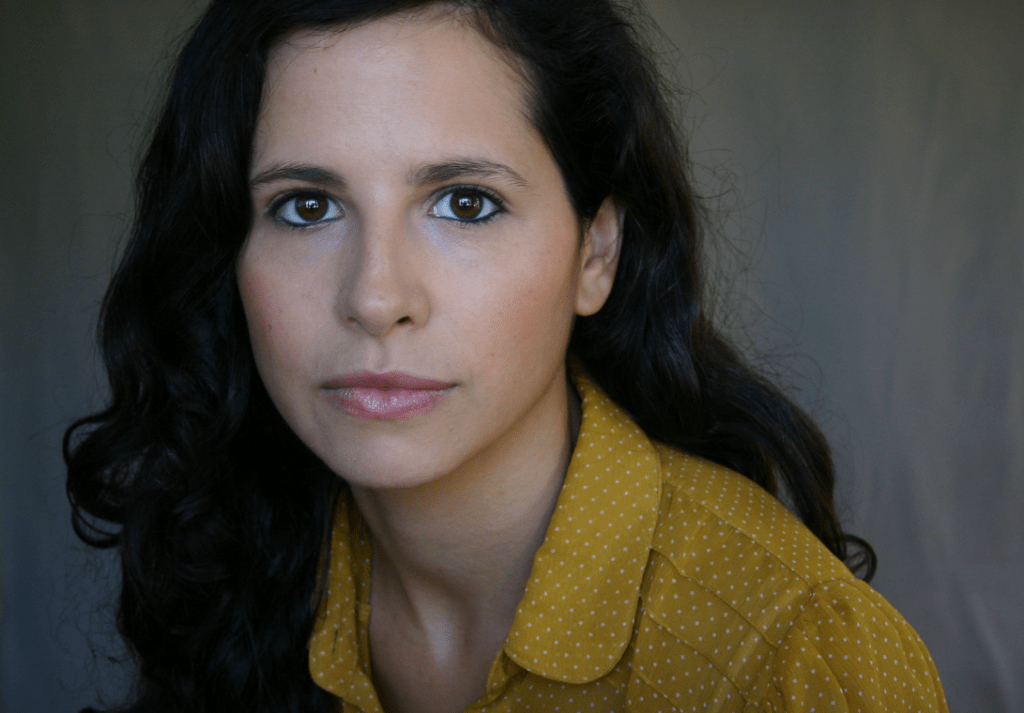
Key to the success of the performance was the actor Clara Perez (pictured), who told the complex story with a beautiful sense of timing and character that drew the (woefully meagre) audience into the drama. Stage director, Nicholas Renton, created a dynamic role for Blanca and, to a lesser extent, the two singers. She acted throughout the evening, maintaining a real presence during the music.
I am not sure if this was a reduced performance from The Telling’s normal show, but the promise of “full staging and stunning lighting” was perhaps a little ambitious. Apart from the actual stage of the Haymarket Theatre and the spinning wheel, there were no props, scenery or other trappings of staged performances other than costumes. The lighting was rather problematic, with several scenes taking place well out of the lighting zones, The whole performance was very quiet, even from my seat close to the front. This might have been realised in rehearsal because there were two live microphones, but they were positioned at the very front and to the extreme sides of the stage. Only once did they pick up and amplify any sound, when the actor was briefly sitting next to one of them.
The Telling and Clare Norburn have been performing imaginative ‘concert-plays’ like this for some time now, and they are well worth following. A trailer, with a different actor and singers, can be viewed here. Basingstoke could do with more imaginative early music performances like this, although they will need better promotion and advertising to draw a larger crowd.
 Andrew Benson-Wilson : Early Music Reviews +